Medical Office Cleaning Requirements: OSHA, CDC and EPA
What OSHA's Bloodborne Pathogens Standard, CDC guidance and EPA disinfectant labels mean for cleaning a medical or dental office, with room checklists.
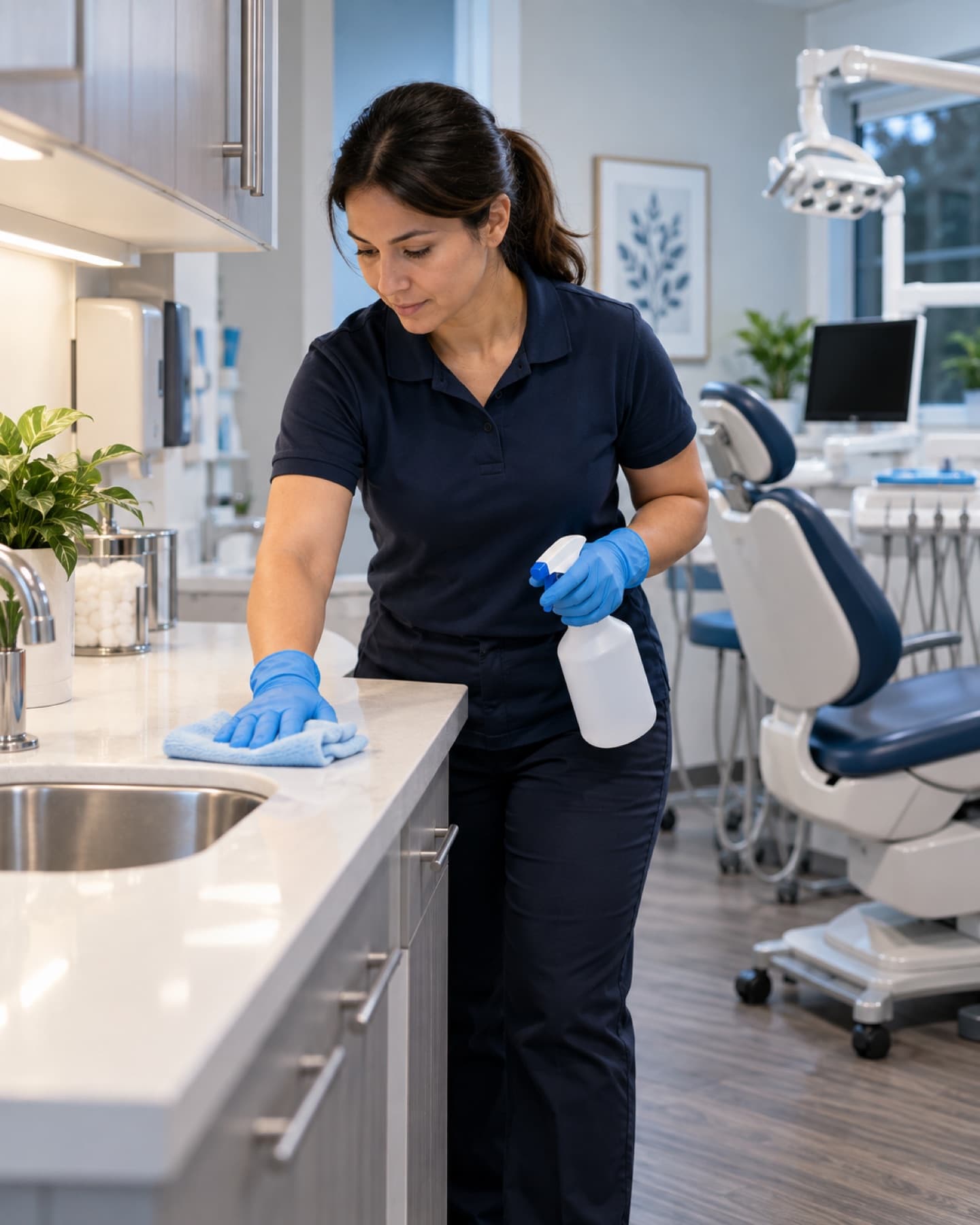
Three federal sources shape medical office cleaning. OSHA's Bloodborne Pathogens Standard (29 CFR 1910.1030) requires a written cleaning schedule and disinfection of contaminated surfaces. CDC guidance sets the expectations for outpatient and dental cleaning. EPA registers disinfectants, and each label sets a contact time: how long the surface must stay wet.
What does OSHA require for cleaning a medical office?
The OSHA standard applies to employers whose employees have "occupational exposure": reasonably anticipated contact with blood or other potentially infectious materials (OPIM) as part of their job. Every such employer must have a written Exposure Control Plan. For cleaning, the key parts are in paragraph (d)(4), Housekeeping:
- A written cleaning schedule. The employer must keep the worksite clean and sanitary, and set a written schedule for cleaning and a method of decontamination. Both depend on the location, the type of surface, the type of soil and the procedures done in the area.
- Decontaminate after contact with blood or OPIM. Equipment and environmental and working surfaces must be cleaned and decontaminated after contact.
- Timing for contaminated work surfaces. Decontaminate with an appropriate disinfectant after procedures are completed, immediately or as soon as feasible after a spill or obvious contamination, and at the end of the work shift if the surface may have been contaminated since the last cleaning.
- Broken glass. Glassware that may be contaminated must never be picked up by hand. Use a brush and dustpan, tongs or forceps.
What counts as an "appropriate disinfectant"? In a 2010 interpretation letter, OSHA says EPA-registered tuberculocidal disinfectants, or household bleach (5.25% sodium hypochlorite) diluted between 1:10 and 1:100 with water, are appropriate for decontaminating blood or OPIM.
What does the CDC recommend for outpatient cleaning?
The CDC's Guide to Infection Prevention for Outpatient Settings (version 2.3, September 2016) sets minimum expectations for clinics, physician offices and other places where patients don't stay overnight. On environmental cleaning, it says:
- Facilities should have written policies and procedures for routine cleaning and disinfection of surfaces, as part of their infection prevention plan.
- Cleaning removes visible soil and must always come before disinfection.
- Focus on surfaces most likely to be contaminated: those close to the patient and those touched often, like doorknobs.
- Cleaning should be assigned to appropriately trained staff, and procedures should be monitored to make sure they're done consistently.
- Use EPA-registered disinfectants with label claims for healthcare use, and follow the manufacturer's directions for amount, dilution, contact time, safe use and disposal. Don't use a disinfectant as a cleaner unless the label says it is suitable for that.
The guide's companion checklist asks whether cleaning staff are trained when hired, every year, and when protocols change, and whether the facility audits products for dilution and contact time. When contract personnel do the cleaning, it says the facility should verify that the contracting company provides this training.
What the CDC says for dental offices
The CDC's dental environmental infection control guidance splits surfaces into two groups:
- Clinical contact surfaces (light handles, bracket trays, switches, computer equipment) should be covered with barriers changed between patients. Without barriers, clean and then disinfect with an EPA-registered, low-level hospital disinfectant effective against HIV and HBV. If visibly contaminated with blood, use an intermediate-level hospital disinfectant with a tuberculocidal claim.
- Housekeeping surfaces (floors, walls, sinks) carry less risk. Soap and water is acceptable, with cleaning and disinfection if they're visibly contaminated with blood. Mops and cloths should be cleaned and dried after use, or be disposable, and cleaning solutions should be made fresh each day.
EPA-registered disinfectants and contact time
The EPA registers disinfectants and reviews their label claims. According to EPA's page on selected registered disinfectants, the only accurate way to identify a product is its EPA registration number, printed on the label. EPA keeps lists by claim, including:
- List S: bloodborne pathogens (HIV, hepatitis B and hepatitis C).
- List B: tuberculosis (Mycobacterium tuberculosis).
- List K: Clostridium difficile (C. diff) spores.
- List N: SARS-CoV-2, the virus that causes COVID-19.
The label's directions say where and how to use the product. EPA says the surface should stay visibly wet for the entire contact time (also called dwell time), and more product should be applied if it dries early. If the label calls for pre-cleaning, or the surface is visibly dirty, clean it first.
Spraying a counter and wiping it dry right away does not meet a label that asks for minutes of wet contact. Contact times differ by product and germ, so the protocol should name both the product and its time.
Who is responsible: the practice or the cleaning company?
Both have duties. OSHA puts obligations on each employer for its own employees.
The practice is the employer for its own staff. Under the OSHA standard it needs an Exposure Control Plan and a written cleaning schedule for its worksite. Under CDC guidance it should have written cleaning policies, name who is responsible, and verify the training of contract cleaners.
The cleaning company is the employer of its crew. OSHA has said that housekeeping workers in healthcare facilities may have occupational exposure, and that it is the employer's job to decide which tasks involve exposure. Where crew members have occupational exposure, the standard requires their employer to provide training, protective equipment at no cost, and access to the hepatitis B vaccine.
A practical way to divide the work:
| Task | Suggested owner |
|---|---|
| Between-patient turnover of clinical contact surfaces and barriers | Clinical staff |
| Instruments, sterilization and device reprocessing | Clinical staff |
| Sharps containers and regulated medical waste | Clinical staff (and your medical waste vendor) |
| Blood or body fluid spills during the day | Clinical staff, per the exposure control plan |
| End-of-day cleaning and disinfection of exam rooms, per protocol | Cleaning company |
| Waiting room, reception, restrooms, break room and floors | Cleaning company |
| Regular trash and high-touch points throughout the office | Cleaning company |
Whatever the split, the crew should know what it must not touch: sharps containers, regulated waste, instruments and anything marked biohazard.
Medical and dental office cleaning checklists by room
These lists cover the after-hours visit. Use the products and contact times named in your protocol.
Exam and treatment rooms
- Clean, then disinfect exam tables, chairs and armrests.
- Clean, then disinfect counters, sinks, faucets and paper towel and soap dispensers.
- Disinfect high-touch points: door handles, light switches, cabinet pulls, stools and keyboards (if the practice approves).
- Leave each surface wet for the label contact time.
- Empty regular trash and replace liners. Leave sharps and regulated waste to clinical staff.
- Damp-mop the floor with the agreed product, working toward the door.
Waiting room and reception
- Disinfect chair arms, seat edges, check-in counters, pens and clipboards left out, and door handles.
- Wipe tables and any children's area surfaces.
- Vacuum carpet and damp-mop hard floors.
Restrooms
- Clean, then disinfect toilets, sinks, faucets, grab bars and flush handles.
- Disinfect door handles, locks, dispensers and baby-changing stations.
- Restock paper and soap, and empty trash and sanitary bins.
- Mop the floor with disinfectant.
Our office cleaning checklist covers break rooms, weekly tasks and quarterly detail work.
What to put in a written cleaning protocol with your vendor
A protocol turns the guidance above into instructions the crew follows every visit:
- Rooms and surfaces in scope, with a frequency for each.
- Products by EPA registration number, with the dilution and contact time for each.
- Order of work: clean before disinfecting, and move from cleaner areas to dirtier ones.
- What the crew must not touch: sharps containers, regulated waste, instruments, patient records and any equipment you name.
- Spill procedure: who handles blood or body fluid spills, and what the crew does if it finds one.
- Protective equipment the crew wears, and the cleaning company's training for its crew.
- Mops and cloths: color-coding or separation by area, and laundering or disposal.
- Records: a report after each visit showing what was done.
- Contacts and review: who to call when something is missed, and when the protocol is reviewed.
Questions to ask a medical office cleaning company
- Will you write a protocol with us before the first visit, and follow it every visit?
- Which disinfectants do you use? Can we see the EPA registration numbers and contact times?
- How do you make sure surfaces stay wet for the full contact time?
- How are your crew members trained for healthcare settings, and can you show us how you verify it?
- Do you assess your crew for occupational exposure under the OSHA standard?
- Will the same crew come every visit, and what does your visit report include?
For the general questions to ask any cleaning company, see how to choose a commercial cleaning company. For how medical spaces affect pricing, see our commercial cleaning cost guide.
How Earth Cleaning Solutions cleans medical and dental offices
We clean medical and dental offices across Greater Orlando. We disinfect exam rooms, waiting areas and restrooms following a protocol we agree on with your practice. The same crew comes every visit, early morning or after close, and sends a short report with photos after each one. We're licensed and insured in Florida, and every crew member is background-checked before the first visit.
To start, answer five questions on our estimate page for a preliminary range. Then we schedule a free walkthrough of about 20 minutes and write the protocol and checklist with you.
Get a preliminary range for your practice in under a minute.
Get my quick estimate →Frequently asked questions
Does OSHA require a written cleaning schedule for a medical office?
Yes, for employers covered by the Bloodborne Pathogens Standard (29 CFR 1910.1030). Paragraph (d)(4)(i) requires the employer to set and follow a written schedule for cleaning and a method of decontamination, based on the location, the type of surface, the type of soil and the procedures done there.
What disinfectant does OSHA consider appropriate for blood spills?
In a 2010 interpretation letter, OSHA says EPA-registered tuberculocidal disinfectants, or 5.25% household bleach diluted between 1:10 and 1:100 with water, are appropriate for decontaminating blood or other potentially infectious materials.
What is disinfectant contact time?
Contact time, or dwell time, is how long a disinfectant must stay on a surface to work. EPA says the surface should stay visibly wet for the whole contact time on the label, and you should apply more product if it dries early.
Is the cleaning company or the practice responsible for OSHA compliance?
Each employer is responsible for its own employees. The practice needs an exposure control plan and a written cleaning schedule for its worksite. The cleaning company must decide whether its crew has occupational exposure and, if so, provide training, protective equipment and access to the hepatitis B vaccine.
Should my cleaning company handle sharps or medical waste?
It's usually safest to leave sharps containers and regulated medical waste to clinical staff and your medical waste vendor. Whatever you decide, write it in the cleaning protocol so the crew knows exactly what not to touch.