
Rainy Season Office Cleaning in Orlando: A Seasonal Guide
Orlando's rainy season tracks water and grit into offices and keeps humidity high. How to protect entries, floors, restrooms and carpets, May to October.

Orlando's rainy season runs from late May to mid-October. The National Weather Service puts the median start at May 27 and the end at October 15. Afternoon storms track water and grit through entrances, humidity slows floor and carpet drying, and restrooms hold odor. More matting, faster spill response and humidity control keep an office clean.
When is rainy season in Orlando?
The NWS Melbourne office, which covers Orlando, lists a median wet-season start of May 27 and a median dry-season start of October 15 for Orlando, based on records back to 1950 (NWS Melbourne). "Median" means half of years start earlier and half later, so some years begin in mid-May and others in June.
According to the same office, June through September are the wettest months. The season is driven by sea breezes from both coasts that collide over the middle of the state and build afternoon thunderstorms, and its onset is marked by dew points of 70 degrees or higher (NWS Melbourne, "Florida Rain Machine"). Tropical systems can still bring heavy rain into October and November.
For an office, that means two things for about five months: wet shoes coming through the door most afternoons, and humid air all day.
What do afternoon storms do to entrances and floors?
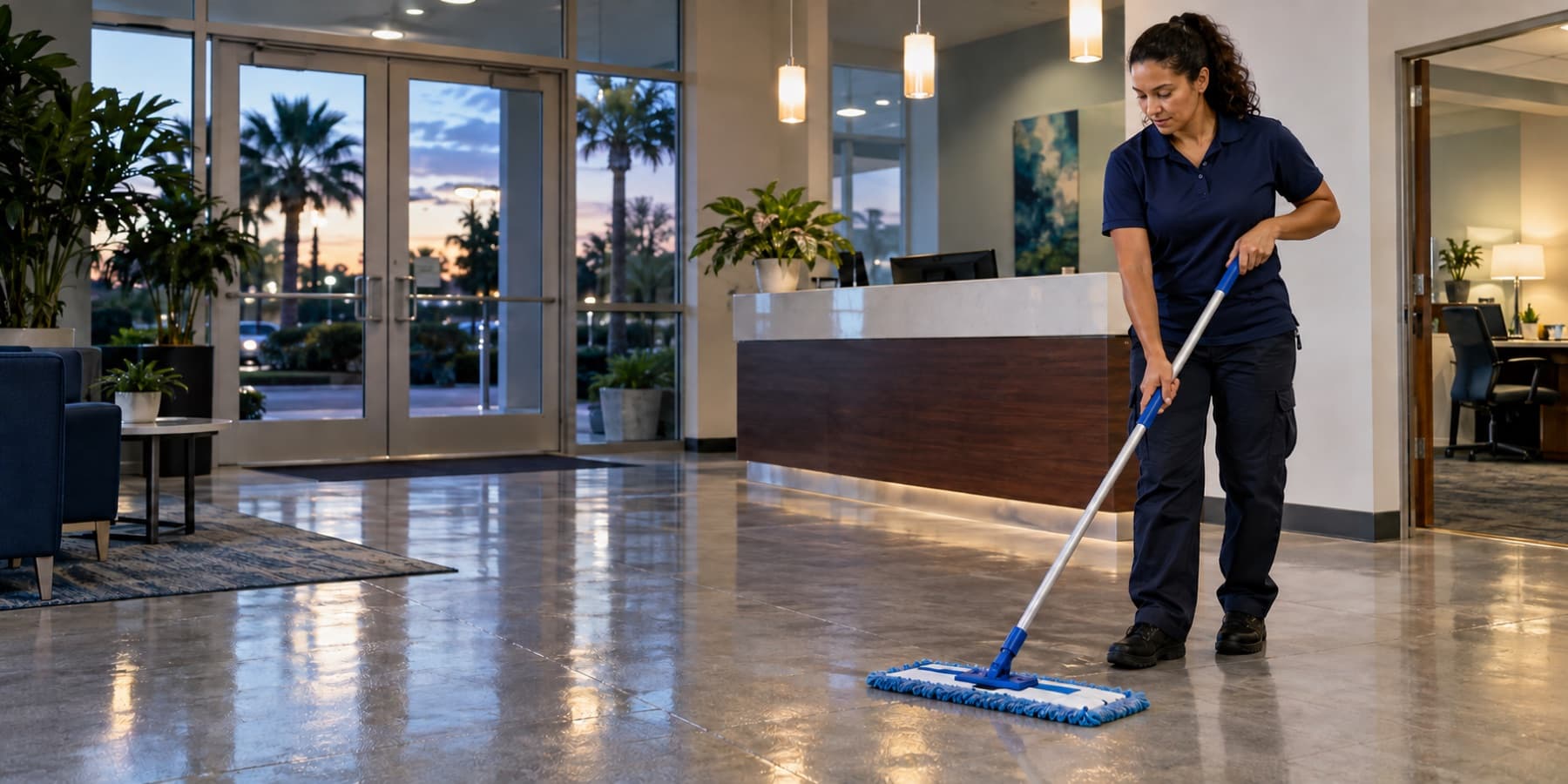
Rain alone is not the problem. Rain mixed with sand, soil and parking-lot grit is. Every person who walks in after a storm carries a little of it, and the first few steps inside the door take the worst of it.
- Hard floors get a gray film and fine scratches that dull the finish over a season.
- Carpet near the door turns darker in the walking lanes and can stay damp underneath.
- Entry glass collects splash marks and handprints from people pushing wet doors.
- Wet floors become a slip hazard, often in the afternoon when the crew isn't there.
OSHA's walking-working surfaces rule requires that workroom floors be kept clean and, to the extent feasible, dry (29 CFR 1910.22). In practice, that means a plan for the hours between cleaning visits: wet-floor signs near the door, a spare mop or absorbent pads, and someone on your team who knows where they are.
What is a good entry-mat strategy for rainy season?
Mats are the cheapest way to keep water and grit off your floors. A simple setup works for most offices and storefronts:
- Outside the door: a coarse scraper mat that knocks sand and grit off shoes.
- Just inside: an absorbent wiper mat long enough that each foot lands on it more than once.
- Spares: a second set of indoor mats, or a mat rental service, so a saturated mat can be swapped on storm days.
- Every cleaning visit: vacuum the mats and clean the floor around and under them.
- Weekly: lift mats, clean and dry the floor underneath, and check for curled edges that can trip people.
A soaked mat stops working and starts spreading water. If your mats are wet to the touch every evening, you need more matting length or more frequent swaps.
Why do restrooms smell worse in summer?
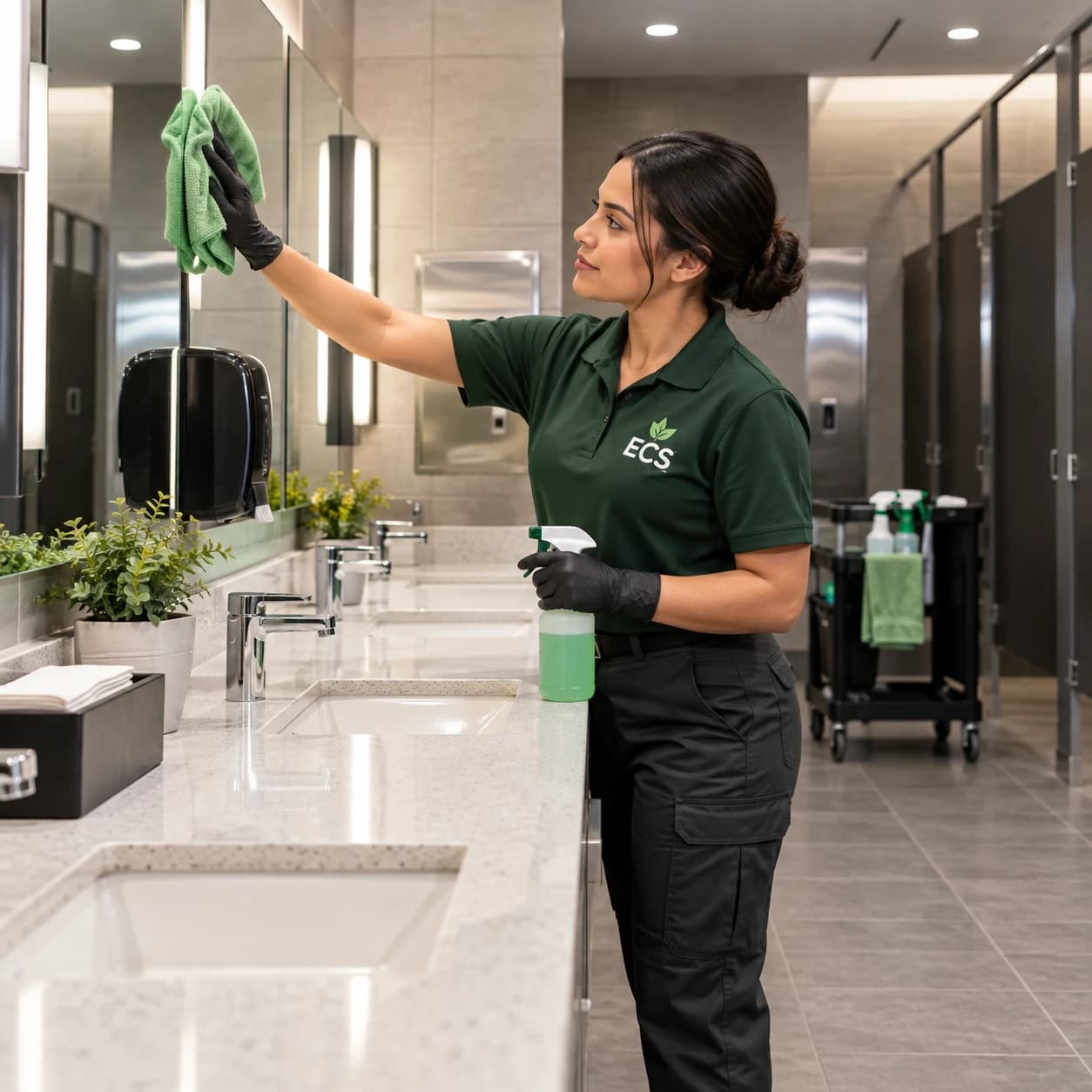
Humid air holds odors longer, and surfaces dry slowly. Grout, mop heads, floor corners and trash liners stay damp, which is where smells start. A few habits help:
- Dry the floor after mopping instead of leaving it to air-dry.
- Use clean, dry mop heads every visit. A damp mop head spreads odor from room to room.
- Keep exhaust fans working and running. Report one that is weak or noisy.
- Pour water into floor drains in rarely used restrooms so the traps don't dry out and let sewer smell in.
- Give grout and the base of toilets detail attention more often during the season.
How should carpets be cleaned in humid months?
EPA guidance for commercial buildings says to clean and dry wet or damp spots within 48 hours to prevent mold (EPA Mold Remediation in Schools and Commercial Buildings). Carpet near a wet entry can stay damp in the backing even when the surface feels dry.
Hot-water extraction is a thorough deep clean for commercial carpet, but timing matters in summer:
- Schedule extraction for an evening or a weekend, so carpets have time to dry before people walk on them.
- Keep the AC running and add fans to speed drying.
- Avoid over-wetting. More water is not cleaner if it can't dry.
- Spot-clean walking lanes between extractions instead of waiting for a full clean.
- Plan a full extraction at the end of the season, in October or November, to remove what the summer tracked in.
How do humidity and AC affect dust and mold indoors?
EPA recommends keeping indoor relative humidity below 60 percent, ideally between 30 and 50 percent (EPA, A Brief Guide to Mold, Moisture and Your Home). EPA's mold course notes that humidity above 60 percent is likely to cause condensation in a building, which can lead to mold growth (EPA Mold Course, Chapter 2). EPA also advises keeping HVAC drip pans clean, flowing and unobstructed.
In an Orlando office, the AC does most of the dehumidifying. When it struggles, the signs show up during cleaning: dust that sticks to vent grilles, condensation or dark spots around supply vents, stained ceiling tiles, and a musty smell in closets and back rooms. A cleaning crew can wipe vent grilles and report what they see. Fixing the cause belongs to your HVAC contractor or building management.
Who handles what during rainy season?
| Task | Cleaning crew | Your team or building |
|---|---|---|
| Vacuum and clean under mats | Every visit | |
| Swap saturated mats on storm days | Staff or mat service | |
| Mop and dry entry floors | Every visit | Spot-dry between visits |
| Wet-floor signs during storms | Leave them stocked | Put them out |
| Wipe vent grilles, report condensation | Weekly | |
| AC service, drip pans, humidity | HVAC contractor or building | |
| Carpet extraction | Scheduled add-on | Approve timing |
Rainy-season add-on checklist
Add these to your office cleaning checklist from late May through October:
- Vacuum entry mats every visit, and clean and dry the floor under them weekly.
- Mop and dry the floor inside each entrance every visit.
- Clean entry glass and door handles every visit.
- Use dry mop heads and dry restroom floors after mopping.
- Water floor drains in low-use restrooms weekly.
- Wipe supply and return vent grilles weekly, and note condensation or ceiling stains in the visit report.
- Spot-clean carpet walking lanes as needed.
- Check that wet-floor signs and spare mats are stocked near the door.
- Book a carpet extraction or deep clean for the end of the season.
Busier spaces may need an extra visit a week during the season. Our guide on how often an office should be cleaned helps you decide.
Get a preliminary range for your space in under a minute.
Get my quick estimate →How Earth Cleaning Solutions handles rainy season
We build seasonal tasks into the written checklist we write with you at a free 20-minute walkthrough. The same crew cleans every visit, so they know which entrance floods and which restroom runs damp. Each visit ends with a short report with photos of key areas and notes about anything we see, like condensation at a vent. We also offer carpet and upholstery cleaning with hot-water extraction and deep cleans. See all our commercial cleaning services or start with the online estimate.
Book a free walkthrough and get one fixed monthly price, with seasonal tasks included.
Get my quick estimate →Frequently asked questions
When does rainy season start and end in Orlando?
The National Weather Service office in Melbourne lists Orlando's median wet-season start as May 27 and the median dry-season start as October 15. These are medians, so the actual dates move by a few weeks from year to year.
What indoor humidity should an office keep to prevent mold?
EPA recommends keeping indoor relative humidity below 60 percent, ideally between 30 and 50 percent. Above 60 percent, condensation becomes likely, which can lead to mold. Your AC system and HVAC contractor control humidity, not your cleaner.
How do I keep office floors from getting slippery when it rains?
Use a scraper mat outside and a long absorbent mat inside, swap mats when they are saturated, keep wet-floor signs by the door, and make sure someone on staff can spot-dry the entry between cleaning visits.
Should carpets be cleaned during rainy season?
Yes, but plan the timing. Schedule hot-water extraction for an evening or weekend, keep the AC running and use fans so carpet dries fully. EPA advises drying wet or damp spots within 48 hours to prevent mold.
Why does my office restroom smell worse in summer?
Humid air holds odors, and grout, mop heads and floor corners stay damp longer. Drying floors after mopping, using clean dry mop heads, running exhaust fans and keeping water in floor drain traps all help.